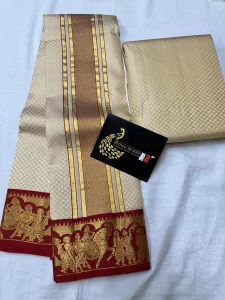
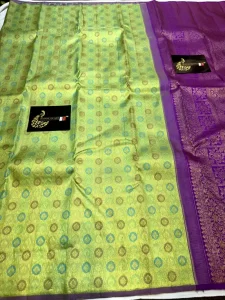
A pure Kanchipuram silk saree is something most families buy only a few times in a lifetime — for a wedding, a first festival, or a daughter’s trousseau. Because it is such an important purchase, it helps to know what separates a genuine handloom Kanchipuram from a power-loom copy or a “Kanchi-style” saree. Here are seven simple checks you can do yourself.
1. Look for the Silk Mark label
The Silk Mark is a quality label run by the Silk Mark Organisation of India under the Central Silk Board, Ministry of Textiles. Only authorised users can attach it, and it certifies that the product is made of pure natural silk. Always ask for the Silk Mark tag and check that the seller is an authorised user. Mystical Six Yards is an authorised Silk Mark user (SMOI/5870).
2. Check the zari with a gentle scratch
Traditional Kanchipuram zari is made from silk thread twisted with silver and coated with gold. If you gently scratch a loose end of the zari, you should see a red or coloured silk core inside. Plastic or polyester zari will show a white or shiny synthetic core and feels stiff and sharp to the touch.
3. Turn the saree over and look at the back
On a handloom saree the back of the border and pallu shows small irregularities, floats and thread ends — signs that a weaver worked it by hand. A machine-made saree looks almost identical and perfectly uniform on both sides.
4. Find the korvai and petni joints
In a classic Kanchipuram, the border is often woven in a contrast colour using the korvai technique, where the body and border are interlocked thread by thread. The pallu is often joined using the petni technique, which leaves a fine zig-zag line where the colours meet. These joints are so strong that the border does not come apart even after years of wear.
5. Feel the weight and the drape
Kanchipuram sarees are woven with three-ply mulberry silk threads, which makes them noticeably heavier and richer than most other silks. Yet a good Kanchipuram still falls in soft, heavy pleats. If a “Kanchipuram” feels very light and slippery, ask more questions.
6. Ask about the burn test
Pure silk burns slowly, smells like burning hair, and leaves a soft ash that crumbles into powder. Synthetic fibres melt, smell like plastic and leave hard beads. Never test on the saree itself — reputed sellers can show you a thread sample.
7. Be careful with prices that look too good
A handwoven Kanchipuram can take a weaver anywhere from several days to many weeks, depending on the design. Pure silk and real zari are costly materials, so a “pure Kanchipuram silk” saree at a very low price is usually a power-loom or art-silk saree.
Buy with confidence
Every saree at Mystical Six Yards is woven by skilled artisans and comes with clear details on the fabric and zari. Explore our Pure Kanchipuram Silk Sarees, or message us on WhatsApp and we will help you choose the right saree for your occasion.